
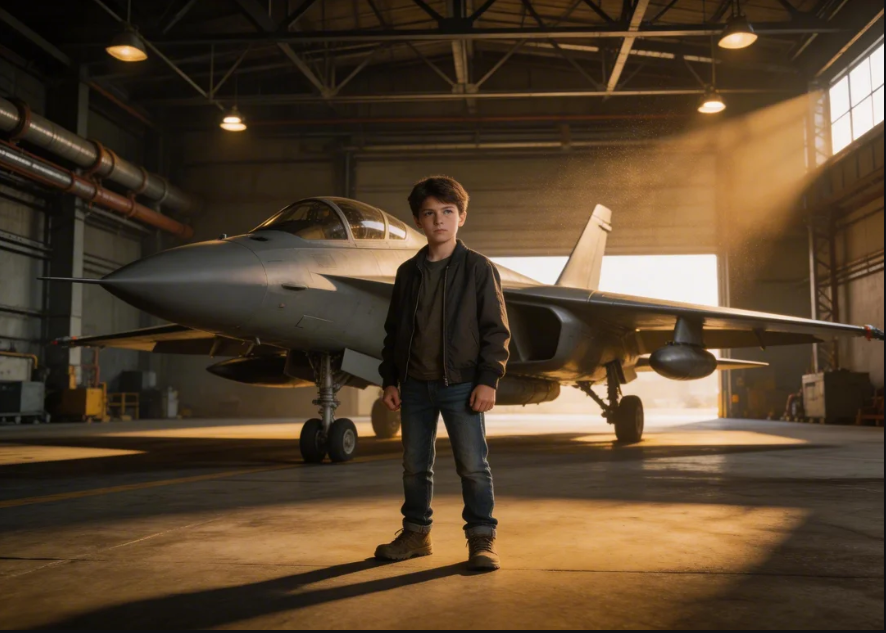
Nobody at Langley Air Force Base could fix Ghost.
That was what the crew called her—the F-16 that had sat in Hangar Seven for six weeks, grounded by an electrical fault that had stumped every technician on base. She was supposed to be back in rotation by now. Instead she just sat there, silent and stubborn, while grown men with decades of experience scratched their heads and argued about diagnostic reports.
Twelve-year-old Eli Carter had no idea about any of that when he followed his father through the hangar doors that Tuesday morning.
He just saw the plane and forgot to breathe.
“Stay close and don’t touch anything,” his father said without looking back. Sergeant Marcus Carter moved through the hangar the way he moved through everything—purposeful, squared, leaving no room for argument. “I mean it, Eli. These men are working.”
“Yes, sir,” Eli said.
He meant it when he said it.
His father disappeared into a briefing room twenty minutes later, and Eli drifted.
He couldn’t help it. The hangar was the most incredible place he had ever been—the smell of hydraulic fluid and metal, the scale of everything, the particular reverence that surrounded machinery that was built to do impossible things. He had been taking apart and rebuilding engines since he was eight. Lawnmowers, motorcycles, his neighbor’s ancient tractor. Anything with moving parts spoke to him in a language he understood better than most people.
Ghost spoke loudest of all.
He circled her slowly, reading her the way he read everything mechanical—not with his eyes exactly, but with some instinct that lived deeper than that. He noticed the access panel on the lower fuselage that sat a quarter inch off alignment. Noticed the faint discoloration near the avionics bay that suggested heat buildup in a place heat shouldn’t be.
He glanced toward the briefing room. Voices. His father was occupied.
He pulled out the small multi-tool he carried everywhere and got to work.
He was forty minutes in when the voice hit him like a thunderclap.
“What in the—son, step away from that aircraft right now.”
Chief Technician Ray Bosch was a large man with a red face and thirty years of Air Force behind him. He crossed the hangar in about four strides and planted himself beside Eli with an expression that made Eli’s stomach drop to the floor.
“I found something,” Eli said quickly.
“You found—” Bosch stopped. Looked at the access panel. Looked at the small, neat arrangement of components Eli had laid out on the cloth beside him. His jaw tightened. “Do you have any idea what you’ve done? Do you have any idea what could have happened if—”
“The primary relay was installed with reversed polarity,” Eli said. “It’s been sending feedback into the avionics every time she powers up. That’s why the fault keeps appearing and disappearing—it’s not consistent because it only triggers above a certain power threshold.” He pointed carefully. “I rerouted it. She should run clean now.”
Bosch stared at him.
Then he looked at the components again.
Then he looked at Eli.
“How old are you?”
“Twelve.”
The briefing room door opened. Sergeant Carter stepped out, scanned the hangar, and went completely still when he saw his son crouched next to the open fuselage of a military aircraft with Chief Bosch looming over him.
“Eli.” His father’s voice was quiet in a way that was worse than shouting. “Come here.”
The conversation was short and happened in the corridor outside the hangar. Eli stood straight and took it—the disappointment, the breach of trust, the seriousness of what he’d done. His father’s voice stayed level throughout, which somehow made it worse.
“You understand why this is a problem,” his father said.
“Yes, sir.”
“Unauthorized access to military equipment—”
“Dad.” Eli met his eyes. “I fixed her. I know I did.”
His father looked at him for a long moment. Then the radio on his belt crackled.
It was Bosch.
“Sergeant Carter.” A pause. “We ran diagnostics on Ghost. Full power cycle. Clean read across the board.” Another pause, longer this time. “Your boy found what six of my guys couldn’t find in six weeks.”
The corridor was very quiet.
His father looked at him—really looked at him—in a way that felt different from before. Like he was seeing something he had always known was there but had never quite focused on.
“Eli,” he said slowly.
“I’m sorry I disobeyed,” Eli said. “I just—I could see what was wrong. I couldn’t walk away from it.”
His father was quiet for a moment. Then something shifted in his expression—the stern line of his mouth softened into something that might, in the right light, have been pride.
“Where did you learn to do that?”
Eli almost smiled. “From watching you fix the truck every weekend for the last four years.”
His father laughed—surprised and real—and pulled him in by the back of the neck the way he did when words weren’t quite enough.
Later, Bosch shook Eli’s hand like he was a colleague. The crew gathered around while he walked them through exactly what he’d found and why it worked.
On the drive home, his father glanced over at him.
“We’re going to need to find you a proper program,” he said quietly. “Something that keeps up with you.”
Eli looked out the window at the sky—wide and open and full of things that were built, by people like him, to fly.
“Yeah,” he said. “I think so too.”