Lucky
Raymond had a system.
He’d learned it over eight months on the streets—which corners got foot traffic, which times of day people were generous, which neighborhoods were worth the walk. He’d learned to keep his sign simple, his eyes down, his presence small. People gave more when they didn’t feel confronted.
They still mostly didn’t give.
He’d been a warehouse supervisor once. Eighteen years with the same company before the layoffs came and took everything with them—the job, then the savings, then the apartment, then the marriage, though that last one had been dying long before. He was fifty-three years old and invisible in a way he hadn’t known was possible until it happened to him.
Some days he made twelve dollars. Some days less. He ate at the shelter on Clement Street when there was space, and when there wasn’t, he ate whatever he could stretch his change to cover. He was not a drunk, not an addict, not dangerous. He was just a man that life had put down and hadn’t helped back up.
Nobody saw the difference.
He found the dog on a Wednesday in October, behind the dumpsters outside a Thai restaurant on Morrison Street.
Small, brown, some kind of terrier mix with a torn ear and ribs you could count. No collar. Eyes that tracked Raymond with the particular wariness of an animal that had been hurt before and was deciding whether to run.
Raymond crouched down slowly.
“Hey,” he said quietly. “I’m not going to hurt you.”
The dog watched him.
“I don’t have much,” Raymond said, reaching into his jacket pocket. Half a granola bar, slightly crushed. He broke off a piece and held it out on his palm.
The dog took one careful step forward. Then another. Then ate the granola bar from his hand with surprising gentleness.
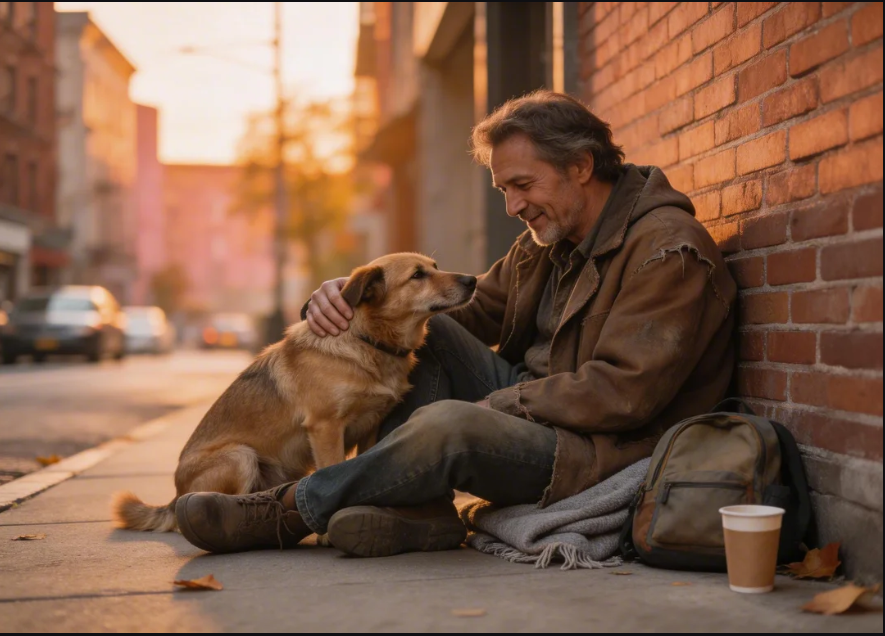
Raymond sat down on the cold pavement and let the dog sniff his jacket for a long time. Eventually, the dog climbed into his lap, turned twice, and settled.
Raymond hadn’t been warm in months.
“Alright,” he said softly. “I guess we’re doing this.”
He named him Lucky, mostly as a joke. Neither of them was, particularly. But the name stuck.
The change happened so gradually that Raymond almost didn’t notice it at first.
People stopped.
Not for him—he understood that quickly enough. They stopped for Lucky, who sat beside Raymond’s cup with his torn ear and his patient eyes and his complete, unconditional presence. Women crouched down to pet him and stood up reaching for their wallets. Men who had walked past Raymond for months without a glance stopped to ask what his name was, how old he was, what kind of mix he was.
“He’s lucky,” Raymond would say, and mean it differently every time.
A woman named Carol who worked at the bakery two blocks over started bringing two coffees in the morning—one for Raymond, one bowl of water for Lucky. A teenager who passed every day on his way to school started stopping to sit with Lucky for five minutes, not saying much, just resting his hand on the dog’s back with the particular relief of someone who needed exactly that.
Raymond watched all of it and felt something shift inside him.
It wasn’t the money, though the money helped. It was something harder to name. Lucky needed feeding, needed walking, needed care. For the first time in eight months, Raymond woke up in the morning because something needed him to.
Purpose, it turned out, didn’t ask where you were sleeping.
Three months after he found Lucky, a man named Dennis stopped at Raymond’s corner. He was older, heavyset, with the look of someone who had built things with his hands his whole life.
“That your dog?” Dennis asked.
“Yes, sir.”
Dennis watched Lucky for a moment. “I run a logistics warehouse out on the east side. Lost my floor supervisor last month.” He looked at Raymond directly—not through him, not past him. At him. “You look like a man who knows how to work.”
Raymond was quiet for a moment.
“I was a warehouse supervisor for eighteen years,” he said.
Dennis nodded slowly. “You got somewhere to clean up?”
“I can find somewhere.”
Dennis reached into his wallet and handed Raymond a card. “Monday. Seven a.m. Don’t be late.”
Raymond looked at the card for a long time after Dennis walked away. Lucky put his chin on Raymond’s knee.
“What do you think?” Raymond asked him.
Lucky’s tail moved once, slowly, like a period at the end of a sentence.
Raymond started on a Monday.
It wasn’t a perfect ending—those only existed in movies. The work was hard and the pay was modest and he still had a long road back to anything resembling his old life. But he had a room in a boarding house now, a worn blanket on a real bed, and Lucky curled at his feet every night like a small, warm anchor.
He thought sometimes about the version of himself from a year ago—the one who had learned to make himself invisible, who had stopped expecting anyone to see him.
Lucky had seen him. And somehow, through Lucky, other people had too.
He reached down in the dark and scratched behind the torn ear.
“Good boy,” he said quietly.
Lucky sighed in his sleep, content and certain in the way that only dogs could be—like the world was exactly the right size, and everything in it was exactly where it was supposed to be.