
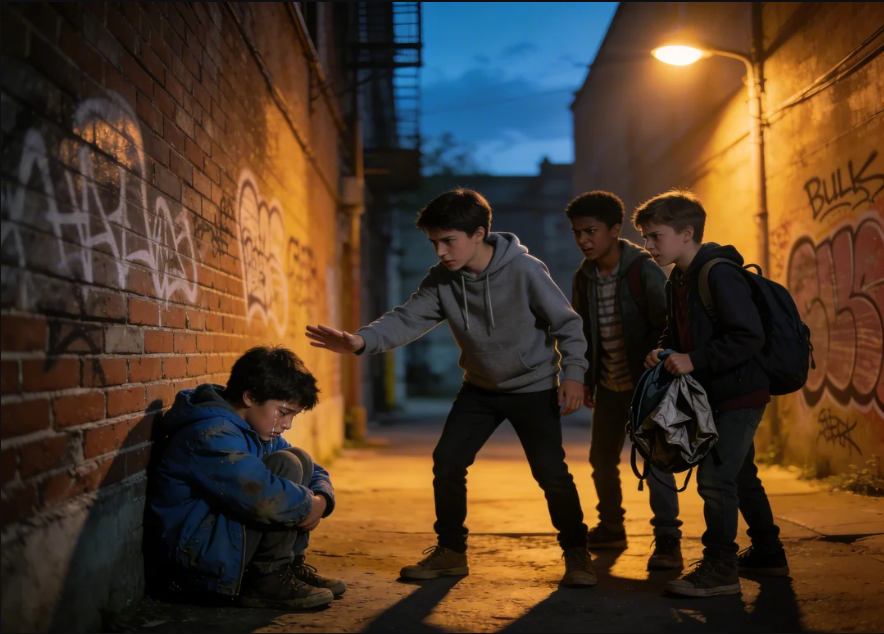
The cafeteria was the worst part of Marcus’s day.
It used to be his favorite—the smell of pizza on Fridays, the loud chaos of a hundred kids talking at once, the way his friends would save him a seat by the window. But that was before Jake and his crew decided Marcus was their favorite target.
“Hey, where you going, loser?”
Marcus kept his head down, tray in hand, trying to find an empty corner. He didn’t make it two steps before Jake’s foot shot out and sent the tray clattering across the floor. Laughter erupted around him. Hot soup spread across the linoleum. Marcus stood there, cheeks burning, staring at the mess.
“Clean it up,” Jake said, smirking. His two friends flanked him like shadows.
Marcus crouched down slowly, picking up the tray with shaking hands. Three months of this. Three months since it started, and not once had anyone stepped in. Teachers looked the other way. His so-called friends had quietly disappeared. He was completely alone in a room full of people.
“I said clean it up properly.” Jake kicked the tray out of Marcus’s hands again.
Marcus closed his eyes. He thought about his brother, DeShawn. What would DeShawn have done? DeShawn wouldn’t have crouched down. DeShawn would have stood up straight, looked Jake dead in the eye, and said something calm and devastatingly cool. DeShawn had always known what to say.
But DeShawn was gone. Had been gone for four years. The accident on Route 9 had taken him two weeks before Marcus’s tenth birthday. There was a funeral. There was a closed casket. There was a mother who cried for a year straight.
Marcus blinked back tears and reached for the tray again.
“Leave it.”
The voice came from the doorway.
It was deep. Quiet. Certain.
Marcus froze.
Jake looked up, annoyed. “Mind your business, man.”
“I said leave it.”
The figure walked through the cafeteria slowly. The room had gone silent in that strange way rooms do when something important is about to happen. Marcus was still crouched on the floor. He didn’t want to look up. He was afraid if he looked up, whoever it was would disappear.
Jake laughed nervously. “Who even are you?”
“Someone who’s been watching for a while.”
Marcus finally looked up.
The world stopped.
The man standing over him was tall, broad-shouldered, with a thin scar above his left eyebrow that Marcus had watched their mom press a bandage over when they were kids. He had their father’s nose and their grandmother’s eyes. He was older—so much older—but Marcus would have known that face in complete darkness.
“DeShawn?” Marcus whispered.
The man looked down at him, and his hard expression cracked open like a shell. Underneath it was something raw and shaking.
“Hey, little brother.”
Marcus couldn’t move. Couldn’t speak. His brain kept rejecting what his eyes were showing him. “You’re dead,” he finally managed. “We buried you. Mom—”
“I know.” DeShawn’s voice broke on those two words. “I know. I’m going to explain everything, I promise. But right now—” he glanced at Jake, who had gone completely pale— “right now I need you to stand up.”
Marcus stood.
Jake and his crew were already backing toward the exit. Nobody said a word. They just left, and somehow Marcus knew, with a certainty he couldn’t explain, that they would never bother him again.
DeShawn turned back to him, and for a long moment neither of them spoke. Four years of silence and grief and unanswered questions sat between them like a wall.
Then Marcus crossed the distance and grabbed his brother, and DeShawn grabbed him back, and Marcus didn’t care that the entire cafeteria was watching. He didn’t care about anything except the fact that his brother’s arms were real and solid and present in a way he had spent four years convincing himself they would never be again.
“I thought you were dead,” Marcus said into his shoulder.
“I know. I’m sorry. I’m so sorry.” DeShawn held him tighter. “I made mistakes. Bad ones. I had to disappear for a while to fix things, to keep you and Mom safe. But I never stopped—” his voice broke again— “I never stopped watching out for you.”
Marcus pulled back and looked at him. There were a thousand questions. There would be hard conversations and confusing answers and probably tears from their mother that would last weeks. There would be nights where the anger hit like a wave—the anger of being left, of mourning someone who wasn’t gone, of carrying that grief alone for four years.
But right now, in this loud and ordinary cafeteria, Marcus looked at his brother’s face and felt something he hadn’t felt in a very long time.
Safe.
“You’ve got really bad timing,” Marcus said finally.
DeShawn laughed—that same loud, surprised laugh Marcus had memorized and thought he’d lost forever.
“Yeah,” he said, wiping his eye with the back of his hand. “I always did.”