
Her Mother’s Money

Vivienne Caldwell had grown up believing her father was a great man. It took twenty-six years and a manila envelope left on her desk by an anonymous source to dismantle that belief entirely. She sat in her office on the forty-second floor of Caldwell Tower—a building that bore her family name on every piece of stationary, every business card, every gleaming elevator door—and read the documents inside three times. Then she set them down, walked to the window, and looked out at the city her father had built his empire on. The numbers didn’t lie. Twelve million dollars, siphoned over eight years from the Vivienne Caldwell Foundation—named after her late mother, funded by donations from thousands of people who believed in her mother’s legacy of children’s healthcare. The money had moved quietly through shell companies and offshore accounts, ending up exactly where it always ended up when her father was involved. In his pocket. She thought about her mother. Eleanor Caldwell had died of cancer when Vivienne was fifteen, and in her final months she had poured everything she had into building that foundation. It was supposed to be her legacy. It was supposed to help children who couldn’t afford treatment. Her father had been stealing from sick children for eight years. Vivienne picked up the documents again and got to work. She had always been the quiet daughter. Her older brother Chase was the one their father groomed for leadership—loud, charming, comfortable in boardrooms. Vivienne had been handed a ceremonial role in the foundation and kept at a comfortable distance from real power. What her father hadn’t accounted for was that she had spent ten years quietly watching and learning everything he never bothered to teach her. She called her mother’s attorney the next morning. “Miss Caldwell.” Gerald Whitmore had been her mother’s most trusted advisor for thirty years. He sounded unsurprised to hear from her. “I’ve been wondering when you’d call.” “You knew?” “I suspected. But without proof—” he paused— “your mother was very specific in her instructions. There was a trust set aside that your father was never informed of. She wanted you to have it when you were ready.” Another pause. “I believe you’re ready.” Vivienne closed her eyes. Her mother had seen this coming. Had quietly, lovingly prepared for it. The trust was forty million dollars. She gave her father one chance. She met him for dinner at his favorite restaurant—the kind of place where the lighting was low and the portions were small and everything cost a fortune. He sat across from her looking exactly like what he was: a man who had never once doubted his own righteousness. “You’ve been stealing from Mom’s foundation,” she said, without preamble. He didn’t flinch. That was the thing about men like her father—they had practiced composure for so long it had become indistinguishable from innocence. “That’s a serious accusation, Vivienne.” “It’s not an accusation. I have documentation going back eight years.” She slid a single page across the table. “I’m giving you the opportunity to make it right before I take this to the board and to the press.” He looked at the paper. Something shifted behind his eyes—not guilt, she realized. Calculation. “You don’t want to do this,” he said quietly. “This family’s reputation—” “Is already destroyed. I’m just the only one who knows it yet.” She folded her hands on the table. “Make it right, Dad. Return the money. Step down. Let me fix what you’ve broken.” He leaned back and smiled the smile she had trusted her entire childhood. “You don’t have the stomach for this, sweetheart.” She picked up the document and put it back in her bag. “I guess we’ll find out,” she said, and left. The board meeting was three weeks later. Vivienne walked in with Gerald Whitmore beside her, a full audit report, and forty million dollars in verified funds ready to be transferred back to the foundation. She presented everything calmly and completely. She answered every question. She did not raise her voice once. Her father sat at the head of the table and said nothing. By the end of the meeting, he had resigned. The foundation was placed under independent oversight. The full twelve million would be repaid. Chase called her that night, furious. “You burned the whole family down,” he said. “I rebuilt it,” she replied. “There’s a difference.” She hung up and sat for a long time in the quiet of her mother’s old study, surrounded by photographs and books and the particular stillness of a room that still held someone’s presence long after they were gone. She thought her mother would have understood. Would have recognized the specific courage it took to love someone and still hold them accountable. She picked up the framed photo from the desk—her mother laughing at something, caught mid-joy—and held it for a moment. “I fixed it, Mom,” she said softly. The city hummed below the window. Somewhere out there, children were getting treatment they couldn’t afford, funded by a foundation that finally meant what it said. That was enough.
The Brother I Lost
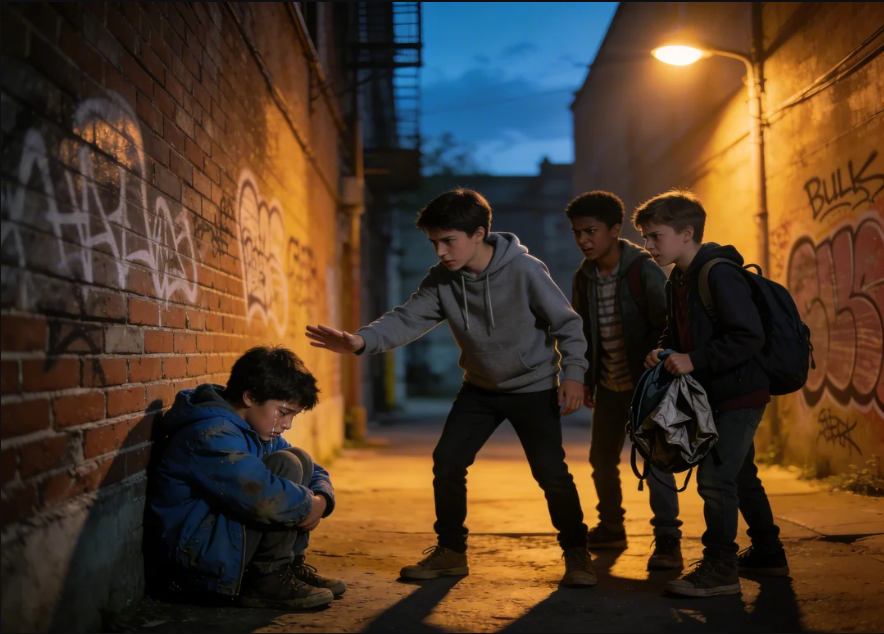
The cafeteria was the worst part of Marcus’s day. It used to be his favorite—the smell of pizza on Fridays, the loud chaos of a hundred kids talking at once, the way his friends would save him a seat by the window. But that was before Jake and his crew decided Marcus was their favorite target. “Hey, where you going, loser?” Marcus kept his head down, tray in hand, trying to find an empty corner. He didn’t make it two steps before Jake’s foot shot out and sent the tray clattering across the floor. Laughter erupted around him. Hot soup spread across the linoleum. Marcus stood there, cheeks burning, staring at the mess. “Clean it up,” Jake said, smirking. His two friends flanked him like shadows. Marcus crouched down slowly, picking up the tray with shaking hands. Three months of this. Three months since it started, and not once had anyone stepped in. Teachers looked the other way. His so-called friends had quietly disappeared. He was completely alone in a room full of people. “I said clean it up properly.” Jake kicked the tray out of Marcus’s hands again. Marcus closed his eyes. He thought about his brother, DeShawn. What would DeShawn have done? DeShawn wouldn’t have crouched down. DeShawn would have stood up straight, looked Jake dead in the eye, and said something calm and devastatingly cool. DeShawn had always known what to say. But DeShawn was gone. Had been gone for four years. The accident on Route 9 had taken him two weeks before Marcus’s tenth birthday. There was a funeral. There was a closed casket. There was a mother who cried for a year straight. Marcus blinked back tears and reached for the tray again. “Leave it.” The voice came from the doorway. It was deep. Quiet. Certain. Marcus froze. Jake looked up, annoyed. “Mind your business, man.” “I said leave it.” The figure walked through the cafeteria slowly. The room had gone silent in that strange way rooms do when something important is about to happen. Marcus was still crouched on the floor. He didn’t want to look up. He was afraid if he looked up, whoever it was would disappear. Jake laughed nervously. “Who even are you?” “Someone who’s been watching for a while.” Marcus finally looked up. The world stopped. The man standing over him was tall, broad-shouldered, with a thin scar above his left eyebrow that Marcus had watched their mom press a bandage over when they were kids. He had their father’s nose and their grandmother’s eyes. He was older—so much older—but Marcus would have known that face in complete darkness. “DeShawn?” Marcus whispered. The man looked down at him, and his hard expression cracked open like a shell. Underneath it was something raw and shaking. “Hey, little brother.” Marcus couldn’t move. Couldn’t speak. His brain kept rejecting what his eyes were showing him. “You’re dead,” he finally managed. “We buried you. Mom—” “I know.” DeShawn’s voice broke on those two words. “I know. I’m going to explain everything, I promise. But right now—” he glanced at Jake, who had gone completely pale— “right now I need you to stand up.” Marcus stood. Jake and his crew were already backing toward the exit. Nobody said a word. They just left, and somehow Marcus knew, with a certainty he couldn’t explain, that they would never bother him again. DeShawn turned back to him, and for a long moment neither of them spoke. Four years of silence and grief and unanswered questions sat between them like a wall. Then Marcus crossed the distance and grabbed his brother, and DeShawn grabbed him back, and Marcus didn’t care that the entire cafeteria was watching. He didn’t care about anything except the fact that his brother’s arms were real and solid and present in a way he had spent four years convincing himself they would never be again. “I thought you were dead,” Marcus said into his shoulder. “I know. I’m sorry. I’m so sorry.” DeShawn held him tighter. “I made mistakes. Bad ones. I had to disappear for a while to fix things, to keep you and Mom safe. But I never stopped—” his voice broke again— “I never stopped watching out for you.” Marcus pulled back and looked at him. There were a thousand questions. There would be hard conversations and confusing answers and probably tears from their mother that would last weeks. There would be nights where the anger hit like a wave—the anger of being left, of mourning someone who wasn’t gone, of carrying that grief alone for four years. But right now, in this loud and ordinary cafeteria, Marcus looked at his brother’s face and felt something he hadn’t felt in a very long time. Safe. “You’ve got really bad timing,” Marcus said finally. DeShawn laughed—that same loud, surprised laugh Marcus had memorized and thought he’d lost forever. “Yeah,” he said, wiping his eye with the back of his hand. “I always did.”