
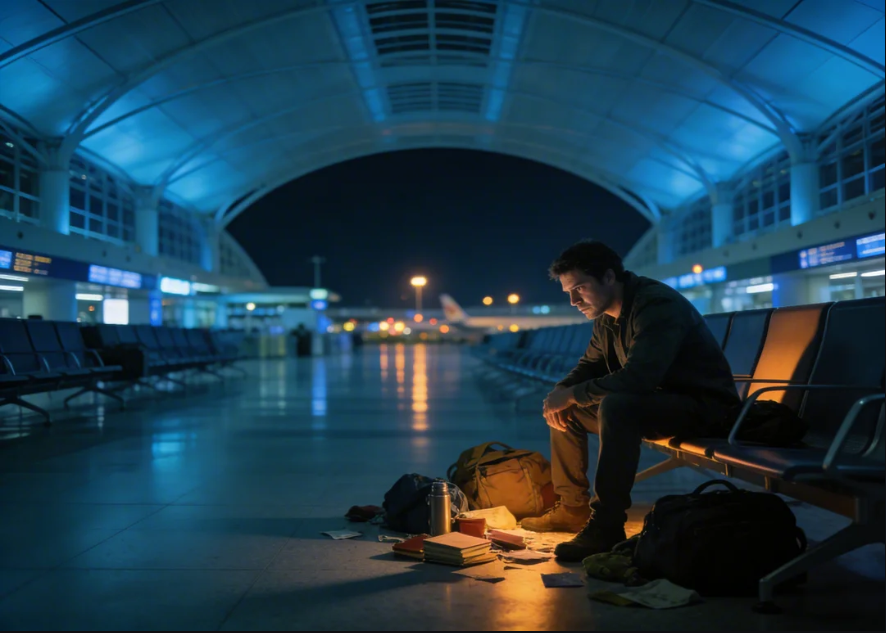
Nobody could agree on exactly when Thomas Adeyemi had arrived.
The morning crew thought he’d been there since Tuesday. The night shift swore it was longer. The truth was that Thomas had stopped counting days somewhere around the third week, when it became clear that counting didn’t help anything.
He had come from Lagos with a connecting flight to Toronto, where his sister had been waiting with a guest room and a job lead and a life that was almost within reach. His passport was valid. His visa was valid. But the single document certifying his residency status—the one piece of paper that would have satisfied the Canadian border authority—had expired by eleven days.
Eleven days.
They wouldn’t let him board his connecting flight. They couldn’t send him back either, because Nigeria had a processing backlog and no diplomatic agreement that covered his particular situation. So Thomas Adeyemi existed, officially, in Terminal B of an airport that belonged to a country that didn’t quite claim him.
He slept on a bench near Gate 14. He washed up in the family restroom before the morning rush. He ate from the food court carefully, making his limited cash last, learning which vendors discarded unsold items at closing time and which security guards looked the other way.
He was not invisible—that was the thing people got wrong about his situation. He was very visible. Everyone just had somewhere else to be.
Rosa found him on his nineteenth day.
She was a cleaning supervisor, fifty years old, with reading glasses she kept losing and a laugh that carried across the entire terminal. She had seen a lot in twenty years of working the same building, but she had never seen a man make a home out of a departure gate with quite so much quiet dignity.
She sat down next to him one morning while he was reading a paperback he’d found on a bench.
“You need anything?” she asked.
Thomas looked up. “I’m fine, thank you.”
“You’re not fine. You’ve been sleeping on that bench for three weeks.” She said it without judgment, the way you state weather. “I’m Rosa.”
“Thomas.”
She nodded like they’d agreed on something. The next morning she brought him a proper breakfast from the staff cafeteria. She never made a big deal of it—just set it down and kept moving. But she did it every day after that.
He met others through Rosa. Jerome, the overnight security guard who let Thomas charge his phone at the staff station and talked to him for hours about football. Mei, the bookstore clerk who started setting aside paperbacks she thought he’d like. A rotating cast of gate agents and custodians and food court workers who began to nod at him the way you nod at a neighbor.
He became, in his way, part of the place.
The bureaucracy moved slowly and without apology.
Thomas wrote letters. Made calls from a borrowed phone. Contacted his sister in Toronto who contacted a lawyer who contacted an embassy who sent forms that required other forms. There were weeks when progress felt real and weeks when the whole thing felt like a door that moved backward when you pushed it.
He kept a notebook where he wrote down everything—every call, every name, every reference number. Rosa said it made him look official. Jerome said it made him look like a journalist. Thomas said it made him feel like a person with a purpose, which was the only thing that mattered.
He taught himself French from a phrasebook someone left behind. He helped a lost elderly couple find their gate and translated for a family who spoke neither English nor the local language. He became, without planning to, useful.
“You should work here,” Mei told him one afternoon.
“I can’t even leave here,” he said.
She shrugged. “Same difference.”
On the ninety-third day, the lawyer called.
A temporary humanitarian status had been approved—enough to allow him entry into Canada while his full case was processed. His sister was already on her way to the airport.
Thomas sat with the phone in his hand for a long time after he hung up.
Rosa found him at Gate 14, which had become his unofficial headquarters. She took one look at his face and put her hand over her mouth.
“Go,” she said.
“I need to say goodbye.”
“Then say it fast before I cry in front of everyone.”
He found Jerome and Mei and three other people who had become, without ceremony or paperwork, his people. He shook hands and accepted hugs and promised to write, and meant it.
At the gate, he turned and looked back at the terminal one last time. The endless fluorescent hum of it. The announcements and the rolling luggage and the smell of coffee and recycled air. For ninety-three days it had been the only place in the world that would have him.
He thought about identity—how he had arrived here with documents that said who he was and left with something that no document could capture. The version of himself that had survived this place was quieter and steadier and harder to shake than the man who had arrived with a connecting flight and a guest room waiting.
He belonged to himself now, completely.
That, he thought, was enough to build everything else on.