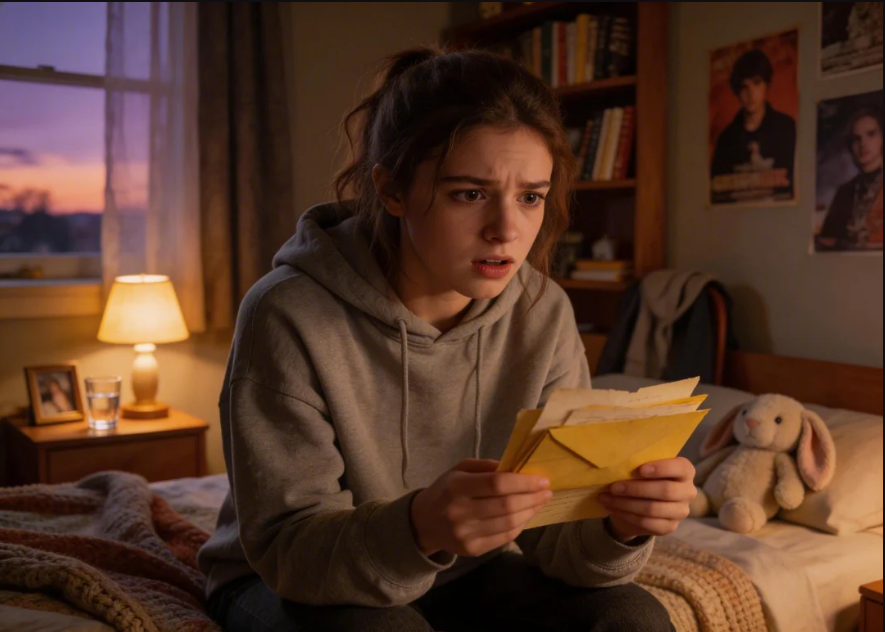
Mia had been looking for her mother’s old scarf.
That was all. A blue scarf her mom had mentioned that morning, something about a church event, something about the hall closet being a disaster. Mia had volunteered to look because she was a good daughter and because she had nothing else to do on a Saturday afternoon.
She found the scarf in ten seconds.
She found the box in twenty.
It was a plain shoebox, tucked behind winter coats, tied with a piece of kitchen twine. She would have left it alone—she wasn’t a snoop—except that her own name was written on the side in her father’s handwriting.
Mia. From the beginning.
She sat down on the closet floor and opened it.
There were photographs first. A hospital room. A woman she didn’t recognize—young, exhausted, tear-streaked—holding a newborn. Mia turned the photo over. On the back, in the same handwriting: Day one. We’re so sorry.
Then letters. Dozens of them, bundled in rubber bands by year. She read with shaking hands, her back against the wall, the scarf forgotten beside her.
They were addressed to an adoption agency. Then to a private investigator. Then, later, to someone named Margaret Cole at an address in Portland—a foster mother, Mia realized slowly. Her foster mother. The one she barely remembered from when she was four.
They had been looking for her. For years.
The last bundle was different—letters that had never been sent, addressed simply to Our daughter. She read one and had to stop.
We were nineteen and terrified and our families told us we had no choice. Not a day has passed that we haven’t regretted it. We found you three years ago. We have been trying to find a way to tell you ever since. We are cowards. We are sorry. We love you more than you will ever know.
Mia sat on the closet floor for a very long time.
Her parents found her there an hour later.
Her mother’s hand went to her mouth. Her father went completely still in the doorway. Neither of them spoke, because there was nothing to say that the box hadn’t already said.
“You’re my biological parents,” Mia said. Her voice came out flat and strange, like it belonged to someone else.
“Yes,” her mother whispered.
“You gave me up. And then you adopted me. And you never told me.”
Her father stepped forward and crouched down to her level. His eyes were red. “Mia—”
“Don’t.” She stood up, needing the height, needing something. “Just—don’t say my name like that right now. Just tell me why.”
So they told her.
They were nineteen when she was born—unmarried, broke, in the middle of college. Both sets of grandparents had been immovable. The shame of it, they had been told. The impossibility of it. They had signed the papers believing they had no choice and spent the next decade knowing they’d been wrong.
Her father had hired a private investigator when he was twenty-seven. It had taken four more years to find her. By then she was in her second foster placement, and the legal path to getting her back was long and complicated and terrifying. They had gone through every step of it. They had waited. They had been approved and rejected and approved again.
They had brought her home when she was eleven.
“We tried to tell you so many times,” her mother said. She was crying openly now. “Every time we tried, we couldn’t find the words that didn’t sound like an excuse. We kept thinking—when she’s older. When she’s ready. When we figure out how to explain the inexplicable.”
“You lied to me for five years,” Mia said.
“Yes,” her father said. He didn’t flinch from it. “We did. And there’s no version of that that’s okay. We were afraid of losing you again and we handled it badly and we are sorry.”
The room was very quiet.
Mia looked at them—these two people she had lived with for five years, who had come to every school play and sat with her through nightmares and taught her to drive in an empty parking lot last spring. She thought about the letters in the box. Twelve years of searching. Twelve years of not giving up.
She didn’t have a clean feeling about any of it. She didn’t think she was supposed to.
“I need time,” she said finally.
“Okay,” her mother said immediately.
“I’m not—” Mia stopped. Started again. “I’m not saying I’m done. I’m saying I need time.”
Her father nodded. Something in his face loosened slightly, like a knot releasing.
She went to her room and closed the door and sat on her bed and stared at the ceiling for a long time. She thought about identity and deception and the difference between the family you were born into and the family that chose you—and then chose you again, and again, for twelve years, across every obstacle that existed.
It wasn’t simple. It might never be simple.
But somewhere underneath the hurt, in a place she wasn’t ready to say out loud yet, she knew something true and complicated and real.
They had never actually let her go.